
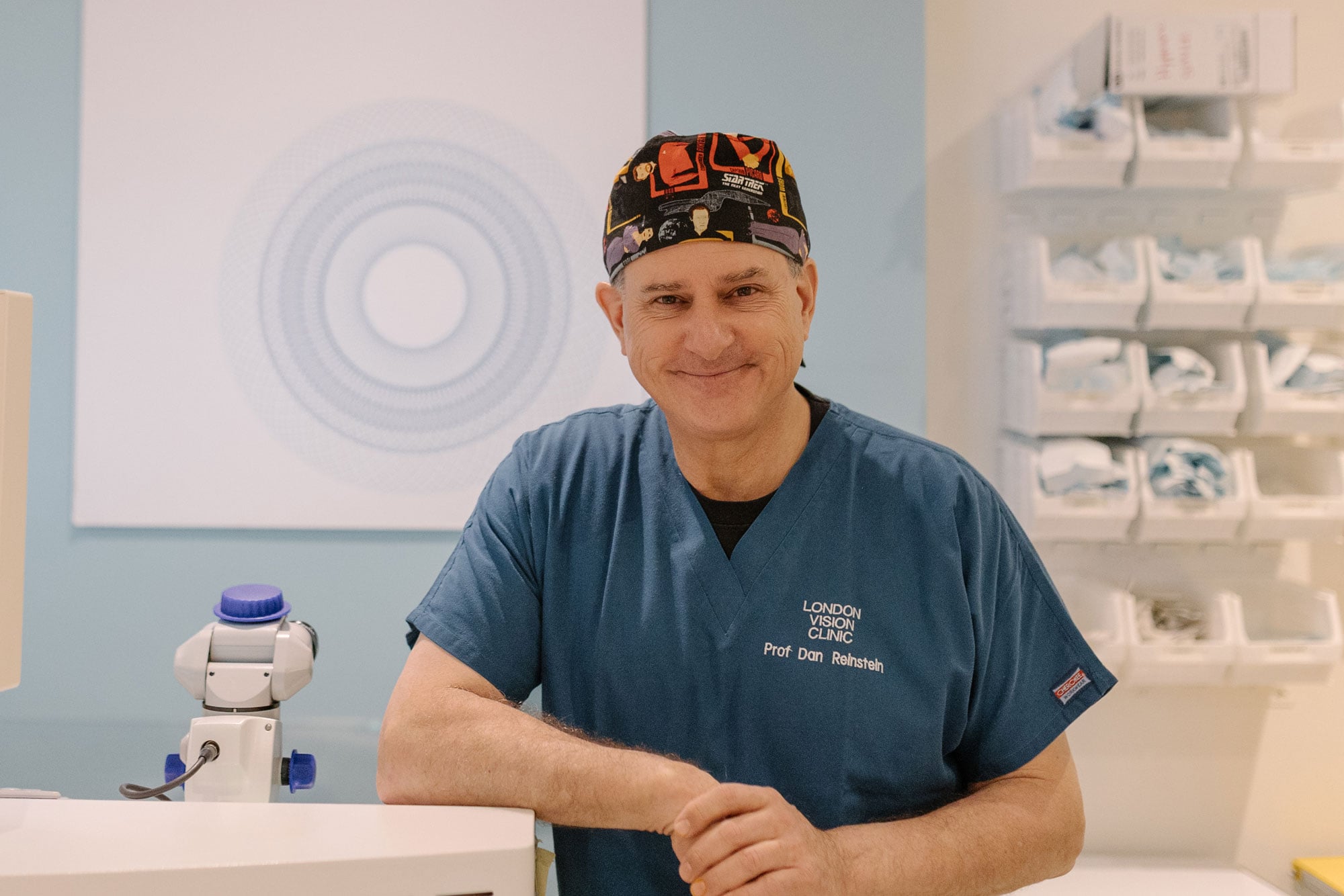

Surgery & Shift: Professor Dan Reinstein , The Visionary Architect of Refractive Surgery
Do you ever feel like the walls of the traditional NHS hospital are starting to close in? Does the idea of a massive, echoing corridor and a three-month waiting list feel a bit… well, last century?
It’s okay to admit it. We’ve all been there.
There’s a massive shift happening in our world right now. It’s a move away from the "everything under one roof" hospital model and towards something far more agile, far more precise, and: let’s be honest: far more exciting. We’re talking about the rise of the refractive mini-hospital.
And if there’s one person who has spent the last two decades drawing up the blueprints for this new era, it’s Professor Dan Reinstein.
At NeedAnOptom.com, we’re obsessed with how the industry is evolving. Why? Because we want you to be in the room when it happens. Let’s have a look at the man, the tech, and the "Shift" that’s redefining your career.
The Architect: A Surgeon with a Saxophone
Before we dive into the lasers and the microns, let’s talk about the man behind the mask. Dan Reinstein isn't your average "by-the-book" consultant.
He’s a Cambridge graduate, sure. He’s performed over 35,000 procedures, absolutely. But he also spent time at the Berklee College of Music in Boston, moonlighting as a jazz saxophonist while studying bioengineering at Cornell.
Why does that matter to you? Because it tells you everything you need to know about his approach to refractive surgery. It’s a blend of rigid, scientific precision and the fluid, improvisational soul of a musician. In a field where "standard" isn’t good enough, Dan is looking for the harmony in the data.
He’s not just following a protocol; he’s composing a solution for every individual eye. That’s the DNA of the London Vision Clinic. It’s not a factory. It’s a boutique centre of excellence where the technology is as refined as a well-rehearsed jazz solo.

The Digital Surgeon’s Toolkit: 1/1000th of a Millimetre
Let’s get technical for a second. If you’re an optometrist reading this, you know that the cornea is a fickle beast. Standard diagnostics give you a good "average" view, but "average" is where mistakes happen.
True.
Dan Reinstein didn’t just wait for better tech to arrive; he helped build it. He’s the co-inventor of the Artemis Insight 100, a VHF digital ultrasound scanner. This thing doesn't just look at the surface; it maps the individual layers of the cornea with a precision of 1/1000mm.
Think about that. One micron.
This level of detail allowed him to pioneer PRESBYOND® Laser Blended Vision, a game-changer for those of us (and our patients) who are tired of reaching for reading glasses. It also made the London Vision Clinic the first in the UK to offer SMILE (Small Incision Lenticule Extraction) back in 2011.
The point? The "Shift" isn't just about moving locations. It’s about moving into a digital medical era where the guesswork is gone.
Built to Care: The Mini-Hospital Philosophy
Now, here is the key. Why are we talking about "mini-hospitals"?
In his book, Built to Care, our very own Krishna de Gruchy explores the philosophy of the patient-centred clinic. It’s a manifesto for the modern age. The core idea is that when you strip away the bureaucracy of a massive hospital and focus on a specialised clinical pathway, the care actually gets better.
Professor Reinstein’s London Vision Clinic is the living, breathing evidence of this "Built to Care" philosophy.
By specialising exclusively in refractive surgery, the clinic can invest in the absolute best technology (like the Artemis) and the most highly trained staff. They aren't trying to fix broken legs or manage diabetes. They are trying to give people perfect vision.
It’s a streamlined, high-octane environment. It’s a mini-hospital. And for the patients, it feels like a private consultation rather than a number in a queue.

The Optometrist’s New Reality: Step Up or Stay Put
Here comes the tough love.
The "Shift" from the NHS to these high-tech community hubs isn't just a win for surgeons; it’s a massive opportunity for you. But only if you’re willing to take it.
As surgery moves out of the hospital, the role of the community optometrist has to evolve. We’re talking about Surgical Co-Management.
Imagine a world where you aren't just doing sight tests and selling frames. Imagine you’re the primary care lead for a patient’s refractive journey. You’re the one identifying candidates for SMILE or PRESBYOND. You’re the one managing their post-operative care, backed by the data from clinics like Dan’s.
Is it scary? Maybe. Is it more responsibility? Definitely.
But it’s also the only way to future-proof your career. The "Shift" is happening whether you like it or not. You can either stay behind the phoropter in a darkened room, or you can join the frontline of the digital medical era.
It’s important to recognise that surgeons like Dan Reinstein need skilled optometrists who speak the same language. They need partners in the community who understand the nuances of corneal topography and the expectations of a refractive patient.
The Worst-Case Scenario?
Let's play a game. What’s the worst that could happen?
You stay where you are. You keep doing the same routine, month after month, year after year. You ignore the "Shift". You ignore the mini-hospital model.
The result? You become a commodity. In a world of online retailers and automated sight tests, if you aren't providing specialised, high-value clinical care, what are you actually doing?
Wow! That’s a bit bleak, isn’t it?
But it’s the truth. The winners in the next decade of optometry will be the ones who align themselves with the visionaries. The ones who look at Professor Dan Reinstein not just as a "laser guy," but as an architect of a new way of working.

How to Make the Move
So, how do you start your own "Shift"?
- Educate Yourself: Learn about SMILE, PRESBYOND, and the Artemis. You don't need to be a surgeon, but you do need to be an expert.
- Read the Playbook: Get your hands on Built to Care. Understand why the mini-hospital model is the future of the optical sector.
- Find the Right Role: If your current practice is stuck in 1995, it might be time for a change. Look for employers who are leaning into co-management and surgical partnerships.
At NeedAnOptom.com, we specialise in connecting ambitious professionals with the practices that are actually leading this revolution. Whether you're a pre-reg or a seasoned vet, there’s a place for you in this new landscape.
It’s Time to Choose
Professor Dan Reinstein didn't become a global authority by playing it safe. He combined Cambridge brains with jazz-musician guts and a refusal to accept "standard" results.
The "Shift" is your invitation to do the same.
The refractive mini-hospital isn't some futuristic dream; it’s happening in London, in Bern, and across the UK right now. The question isn’t whether it’s the future. The question is: are you going to be a part of it?
True.
If you're ready to explore a career that puts you at the heart of this surgical evolution, get in touch with us. Let's find you a role that’s actually "Built to Care."
leave your comment