
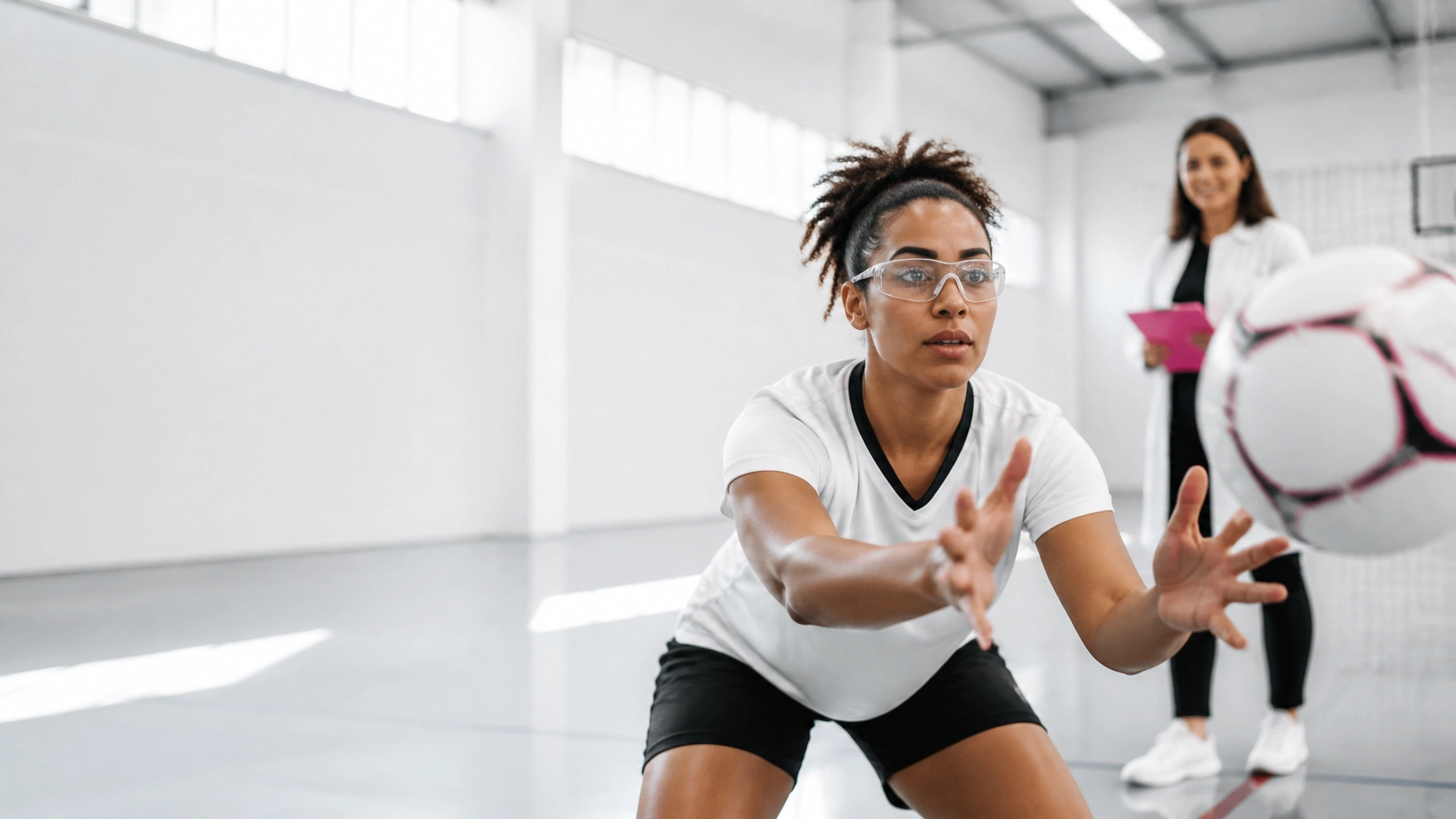

Sports Vision: Seeing Clearly, Moving Safely
Status: DRAFT
National Eye Health Week focus: Saturday 26 September 2026
Do you see the ball clearly but still react too late? Do you lose sight of a teammate in poor light? Does your prescription work perfectly in the consulting room but feel less reliable on the pitch, court or track?
Sports vision is about more than reading the bottom line of an eye chart.
Your sport may demand rapid focus changes, accurate distance judgement, sharp peripheral awareness and reliable vision under pressure. A small visual problem can become a safety issue when you are moving quickly, competing in a crowded space or trying to respond to an object travelling towards you.
At NeedAnOptom Healthcare, we believe specialist optical support should be practical, personal and connected to real life. That includes helping athletes, coaches and teams understand how vision can influence performance and injury prevention.
A standard sight test is important , but sport may demand more
A regular sight test is a vital starting point. It checks your general vision and helps identify or monitor eye and health conditions.
But sport rarely happens in a quiet room with your head still and the target at a predictable distance. You might be running, turning, scanning, judging speed and dealing with glare , all at once!
Let’s have a look at the main visual skills that can matter during sports participation.
1. Visual acuity
Visual acuity is the clarity or sharpness of your vision. It helps you identify a ball, read a scoreboard or recognise a teammate at distance.
Both monocular vision , using one eye at a time , and binocular vision, using both eyes together, can be relevant. Your optometrist may also consider how your vision performs while you are moving or changing focus.
Here is the key point: good visual acuity does not automatically mean perfect sports vision.
You might achieve a strong result on a chart but struggle with contrast, depth perception or visual fatigue during competition.
2. Contrast sensitivity
Can you distinguish a grey ball against a cloudy sky? Can you pick out a teammate wearing a darker kit under changing floodlights?
That is where contrast sensitivity comes in.
Contrast sensitivity describes your ability to see differences between an object and its background. It is particularly relevant in low light, mist, glare or visually busy environments.
An athlete may report that their vision is “fine” in bright conditions, then find it much harder to track objects when the lighting changes. This is not something to brush off. It is useful information for a professional assessment.
3. Depth perception
Depth perception helps you judge how far away something is and how quickly it is approaching.
It supports tasks such as:
- Catching or striking a moving ball.
- Judging when to make a tackle.
- Moving safely around other players.
- Estimating the distance to a target.
- Landing or changing direction accurately.
Depth perception relies heavily on the two eyes working together. If your eyes are not teaming efficiently, you may experience headaches, visual discomfort, poor timing or uncertainty about distance.
4. Reaction time and eye–hand coordination
Seeing the object is only part of the job. Your brain and body must respond to it.
Sports vision assessments may explore visual reaction time, eye–hand coordination, tracking and how quickly you can respond to a target moving at different speeds or angles.
Think of a top tennis player returning a serve. The movement is not random. The player is taking in visual information, predicting the ball’s path and coordinating a physical response in a fraction of a second.
You do not need to be a professional athlete to benefit from understanding these demands. Whether you play at school, at weekends or at elite level, the principle is the same: clear information supports safer, more confident movement.

Your prescription may need to work differently for sport
Are you thinking, “My glasses are fine. I’ve worn them for years”?
Maybe. But ordinary everyday eyewear may not be suitable for every sporting environment.
Your optometrist can discuss whether you need:
- Prescription sports eyewear.
- Soft contact lenses.
- Protective goggles over contact lenses.
- A combination of correction and eye protection.
- Different solutions for indoor and outdoor activities.
The best option depends on your prescription, the sport, the playing environment, the level of contact and your ability to handle lenses safely.
The British Contact Lens Association explains that soft contact lenses are often suitable for sport because they tend to move less than rigid gas-permeable lenses. Daily disposable lenses may also be convenient for occasional sports participation, as they are discarded after use.
However, contact lenses are not eye protection.
That matters. A contact lens may help you see clearly, but it will not protect your eye from a ball, stick, elbow, flying debris or another impact.
If your sport carries an impact risk, you may need purpose-designed protective eyewear as well. For swimming and water sports, tight-fitting goggles should be worn over contact lenses, and the lenses should be discarded immediately afterwards, in line with professional advice. You can read more about contact lenses and sport in the British Contact Lens Association’s guidance.
Eye protection is part of injury prevention
It is tempting to think, “It will probably be fine.”
That is a gamble worth avoiding.
Sports eyewear should be appropriate for the activity, fit securely and use impact-resistant materials. Polycarbonate lenses are commonly recommended for high-risk sports because of their impact resistance. Ordinary fashion glasses are not a substitute for sports protection.
Protective eyewear may be particularly important for sports such as:
- Squash and racket sports.
- Hockey.
- Martial arts and combat sports.
- Rugby and other contact sports.
- Paintball and airsoft.
- Cycling and activities involving flying debris.
- Water sports and outdoor activities.
Rules vary between sports and governing bodies. In some situations, prescription sports eyewear must be supplied under the same conditions as other optical appliances. The College of Optometrists’ guidance on sports eyewear is a useful professional reference.
Your optometrist can help you understand what is suitable for your prescription and what may be permitted for your sport. Do not assume that a pair of protective glasses is automatically safe, legal or appropriate.

After an injury, visual changes need professional attention
This is the tough-love section.
“It’s only a little blurry.”
“It’ll settle down.”
“I’ll wait until tomorrow.”
Please do not ignore a change in vision after an eye injury.
Blurred vision, reduced vision, double vision, new flashes or floaters, sensitivity to light, significant pain or difficulty opening or moving the eye can indicate a problem requiring urgent assessment.
The NHS advises going to A&E or calling 999 if there are any changes to your sight after an eye injury. This includes injuries caused by something hitting the eye at high speed. Do not drive yourself to A&E; ask someone to take you or call 999 if necessary.
If a chemical enters the eye, rinse it with clean water for at least 20 minutes while seeking medical help. Do not rub the eye. Do not try to remove an object that has pierced it.
A professional assessment is important even when the outside of the eye does not look badly injured. Some problems are not obvious without a proper examination.
Your immediate script:
“My vision has changed after an eye injury. I need urgent medical advice.”
That is not overreacting. It is sensible injury prevention.

How optometrists can support athletes and teams
Sports vision works best when it is connected to the wider team.
An optometrist may support athletes and clubs by providing:
-
Baseline assessments
Establishing a record of visual acuity, binocular function, contrast sensitivity and other relevant measures before problems arise. -
Sport-specific advice
Considering the lighting, speed, contact, equipment and visual demands of the activity. -
Correction and eyewear guidance
Helping athletes choose between spectacles, contact lenses, protective goggles or a combination. -
Education for coaches and players
Explaining warning signs, lens hygiene, safe eyewear use and when to stop participating. -
Referral and follow-up support
Making sure visual changes after injury are escalated appropriately and reviewed by the right healthcare professional. -
Support for inclusive participation
Advising on adaptations and communication for athletes with visual impairment, alongside relevant sport-specific requirements.
For clubs, academies and healthcare teams, a structured approach can make follow-up easier. Bespoke ZPC and MyGentic workflows could be designed to support assessment templates, education records, consent processes, referral prompts and scheduled follow-ups. The important word is bespoke. Any workflow should be shaped around the organisation’s clinical requirements, governance arrangements and professional judgement : not treated as a replacement for assessment or care.
NeedAnOptom Healthcare can help connect optical professionals with organisations that value specialist knowledge, careful communication and practical clinical support. You can contact the NeedAnOptom Healthcare team, register for opportunities or explore job alerts.
Seeing clearly is only the beginning
Sport asks a lot from your visual system.
You need to see clearly, judge distance, detect contrast, respond quickly and stay aware of what is happening around you. You also need to protect your eyes and act promptly when something changes.
So, what is the takeaway?
Do not wait for a visual problem to affect your performance : or your safety.
Book a professional assessment if you have concerns about your vision, prescription, contact lenses or sports eyewear. And if your vision changes after an injury, seek urgent medical advice.
Clearer vision cannot guarantee a win. But appropriate assessment, correction and protection can help you participate more safely and confidently.
This article provides general medical information and is not a substitute for an eye examination, diagnosis or individual clinical advice. Sports eyewear, contact lens use and participation decisions should be discussed with a registered optometrist or other appropriate healthcare professional. If your vision changes after an eye injury, follow NHS urgent-care advice and seek immediate help.
NeedAnOptom Healthcare’s website, hosting, development and management are handled by ZeroPoint Creative.
leave your comment